how-sure

English · Русский
Small tools and notes from my work as a petroleum geologist. Each one deals with the same question: how sure are we, and what would make us surer?
Each tool is a single file that opens in a few seconds. The numbers are made up or come from open sources; nothing here comes from a client or an employer. A tool that calculates something ships with an example worked out by hand and built-in checks against it, so you can test the formulas before you trust them.
Tools
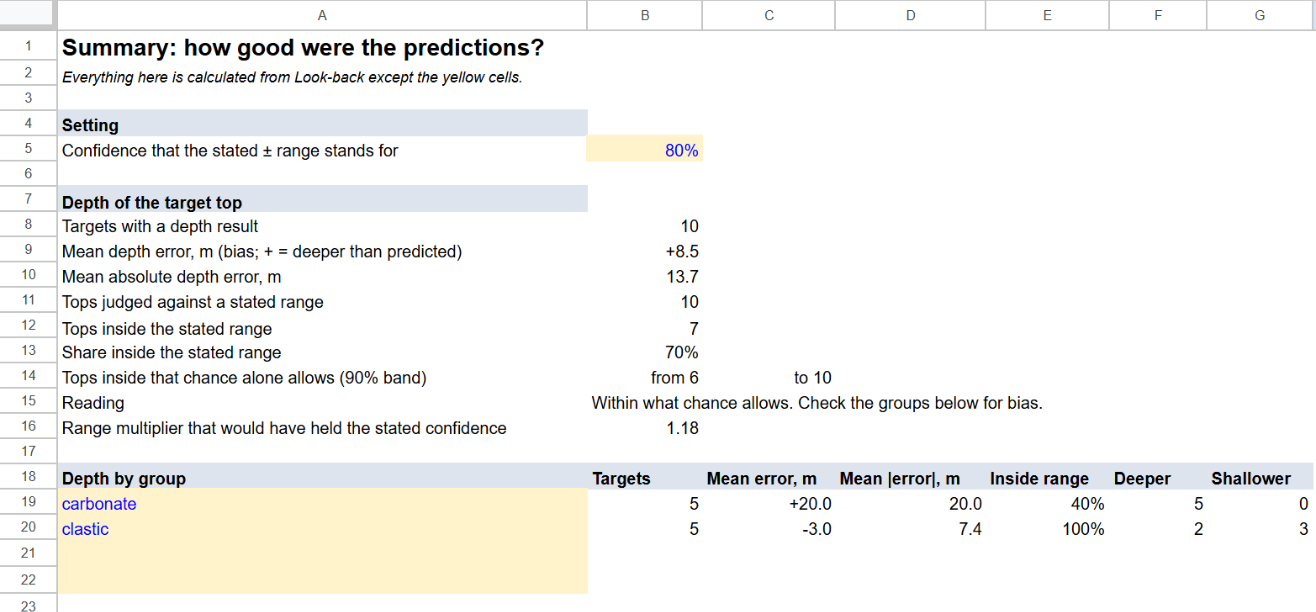
The tools fall into two families. Before the money is spent: what to measure and where, so that the data can answer the question it is bought for (02, a magnetic survey; 03, a shallow drilling campaign), and how much a prospect may hold, as a range, with the data that could change the decision (04). After the well: what the result says about the prediction (01), which also shows how wide the ranges in 04 should be.
| Tool | What it does | Files | |
|---|---|---|---|
| 01 | Prediction vs. result | Post-drill look-back. For every target: the prediction, what the bit found, the difference, its cause, and what changes in the next recommendation. Shows bias by group, how often your ± ranges held once chance is allowed for, and hits that were right for the wrong reason. | Excel · PDF EN RU |
| 02 | Magnetic survey check | What must the survey resolve? Checks a planned magnetic survey before it is flown: for a dyke, a sill edge or a plug, does it stand above the noise, do two bodies show as two, how far apart can the lines be, and what changes between ground, low-clearance UAV, helicopter and fixed-wing heights. | Open the page · HTML |
| 03 | Five wells: which five? | Planning a shallow stratigraphic drilling campaign when only a few wells are allowed: what each next well buys, why dating is the weak link rather than coring, and how the first cores change the wells still to drill. Behind it is a published campaign, the first on the Russian Arctic shelf: 10 wells, 300 m of core, 13 stratigraphic units. | Open the page · HTML · PDF EN RU |
| 04 | How much, and how sure? | A prospect’s oil in place as a range, P90 to P10: why the low case is not every input at its low end, which inputs drive the range, and which data could change the decision. The same calculation as a Monte Carlo spreadsheet. | Open the page · HTML · Excel · PDF EN RU |
Using a tool
- Download the file from its folder, or open the page in the browser.
- Look at the checks first. With the example in place they read ALL PASS (tool 01, Test sheet: ALL 32 PASS; tool 02, bottom of the page: ALL 24 PASS; tool 03, bottom of the page: ALL 49 PASS; tool 04, bottom of the page: ALL 74 PASS, and the Test sheet of its spreadsheet: ALL 38 PASS).
- Then put in your own numbers.
If a number looks wrong, please open an issue.
Licence and citation
Text and templates: CC BY 4.0. Use them, change them, credit the source.
To cite: Balagurov, M. (2026). how-sure: small tools and notes from a petroleum geologist’s work (v1.3). Zenodo. https://doi.org/10.5281/zenodo.24242389. The DOI always points to the latest version; the Cite this repository button gives other formats.
Built with AI assistance; the geology and the checks are mine.
Maxim Balagurov · LinkedIn